Why Golf Course Drainage Stops Working
And How to Restore Performance
Introduction
Many golf clubs have invested significant sums in drainage systems.
A common assumption is that once installed, drains will continue to function indefinitely.
In practice, this is rarely the case.
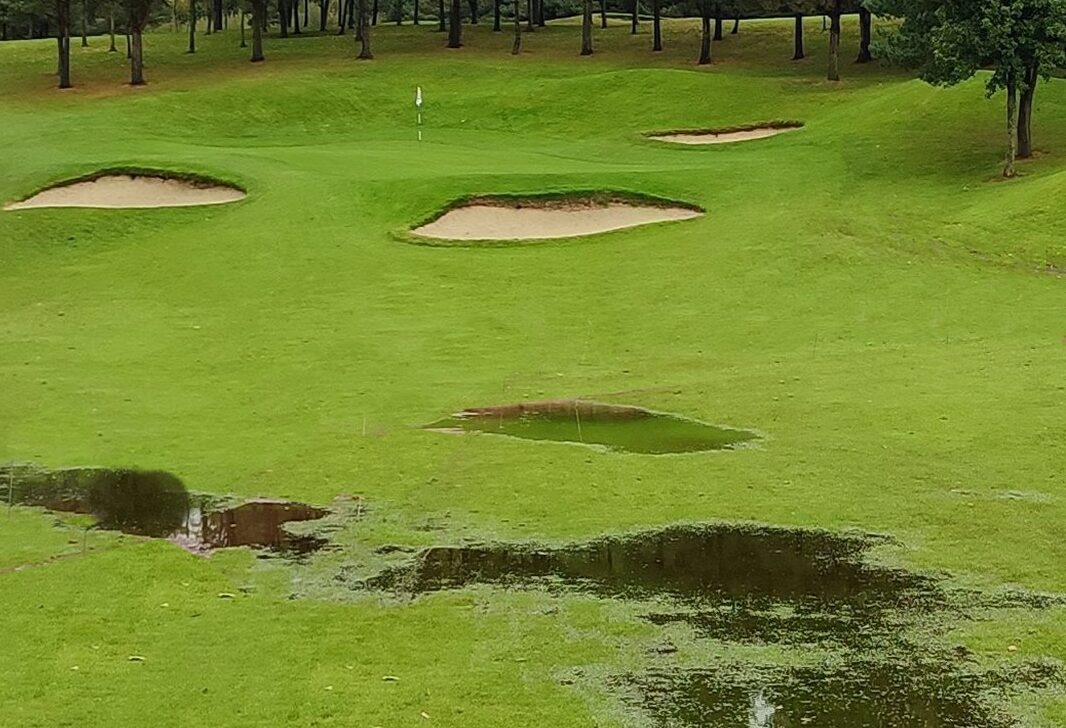
Over time, performance declines, often gradually, until problems begin to reappear. These are frequently attributed to unusually wet conditions, but in many cases the real issue is that the drainage system is no longer functioning as intended.
Key points for golf clubs
- Drainage systems require periodic maintenance
- Gravel-filled drains often seal over and become ineffective
- Refreshing drains is often simple, low-cost and easily carried out
- Outfalls must be checked regularly
- Surface treatments can help, but do not replace proper drainage
- Maintaining existing drains is more cost-effective than installing new ones
An effective maintenance programme will save money, reduce disruption, improve playability and reduce course closures.
1. Why drainage systems lose effectiveness
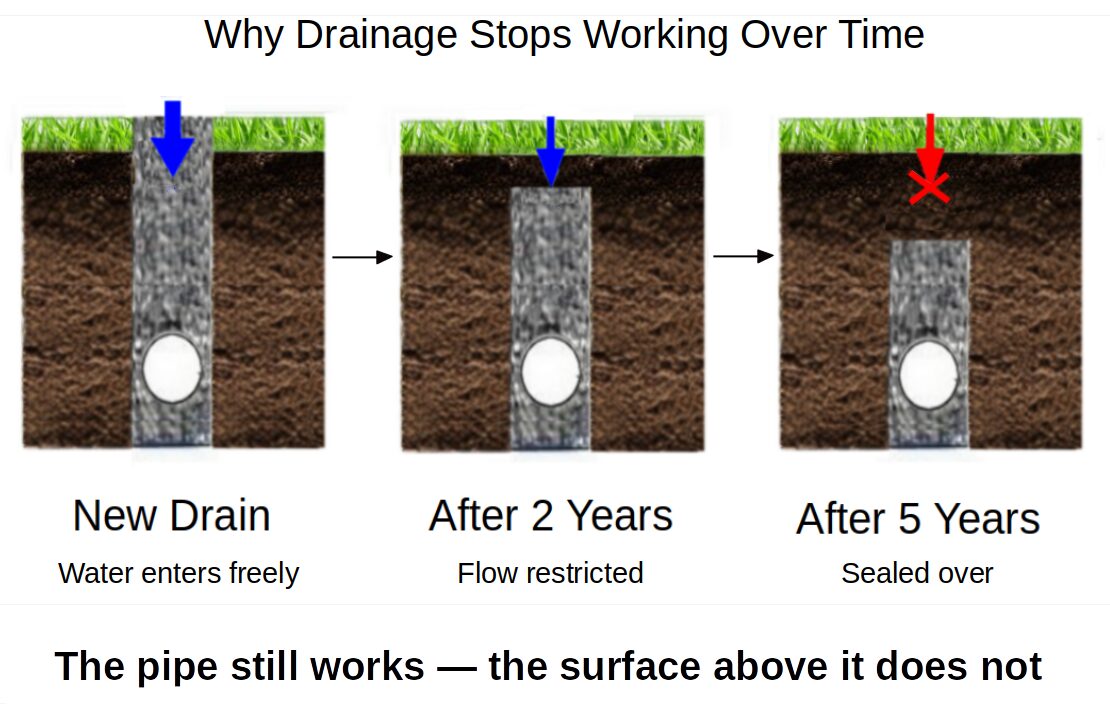
Most golf course drainage systems rely on gravel-filled trenches to collect and convey water.
Over time, the surface of these drains often:
- Seal with organic matter and fine soils
- Become covered by turf
- Lose their ability to allow water to enter
As a result, water no longer reaches the drains efficiently, even though the pipe system itself may still be functioning, as shown below.
2. Refreshing gravel drains
In many cases, performance can be restored by:
Removing the sealed surface layer and exposing clean gravel
This typically involves:
- Removing a shallow depth of turf and organic material
- Replacing or topping up with clean gravel
As a general guide:
- Coarser gravel (approx. 20mm) is suitable for topping drains in the rough
- Fine natural gravel (approx. 6mm) is more appropriate in fairways
This allows water to enter the drains again and usually restores their effectiveness.
Refreshing a drain - restoring performance
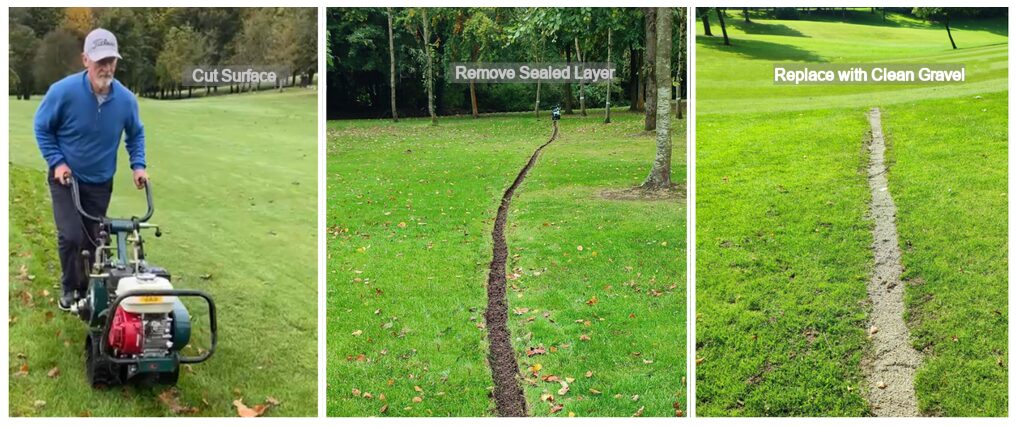
Short lengths of drains can easily be refreshed by removing the sealed surface with a turf cutter and replacing the gravel. Larger areas can be refreshed with a drainage trencher set to shallow depth. This restores water entry into the drainage system.
3. What to avoid
Attempts to cover drains by sanding or turfing over them will often reduce effectiveness. In particular:
- Sand can wash out and seals very quickly
- Seeding or turfing over drains can block them almost immediately
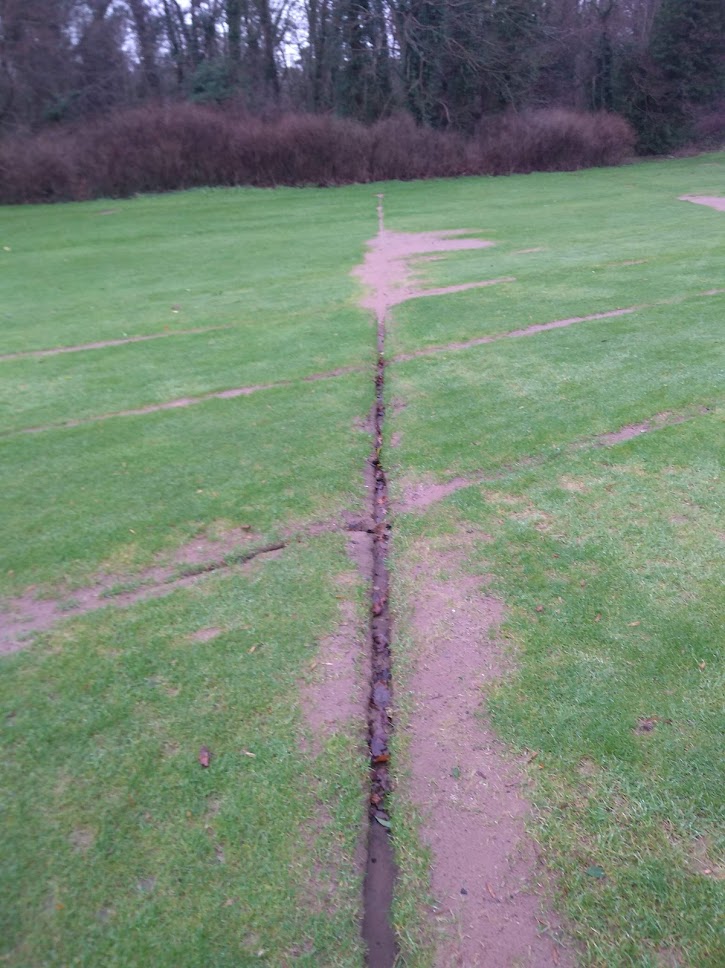
These approaches may be appropriate in high-profile areas, but should be used carefully where drainage performance is the priority.
4. Check the outfalls
Even a well-maintained system will not function if the outlet is blocked. Common issues include:
- Sediment build-up in ditches or streams
- Vegetation growth
- Debris accumulation
Regular inspection is simple and often overlooked.
5. Gravel banding - a useful tool, not a solution
Gravel banding is not a primary drainage system.
It is best understood as a maintenance tool to help water reach existing drains with minimal disturbance, when ground conditions are suitable.
It involves forming narrow, shallow grooves filled with gravel. However:
- These grooves can seal quickly at the surface
- They are easily blocked
- Their effectiveness is limited
Gravel banding works best:
- Over short distances (typically no more than 20 metres)
- Where it feeds into effective drains or permeable soils
These conditions are often not present on poorly drained courses.
Timing is also important:
- Best carried out in dry conditions (e.g. autumn)
- Installation in soft ground can cause damage with little benefit
It also needs to be repeated regularly.
Used correctly, gravel banding is effective. Used indiscriminately, it becomes a short-term fix that does not address the underlying problem.
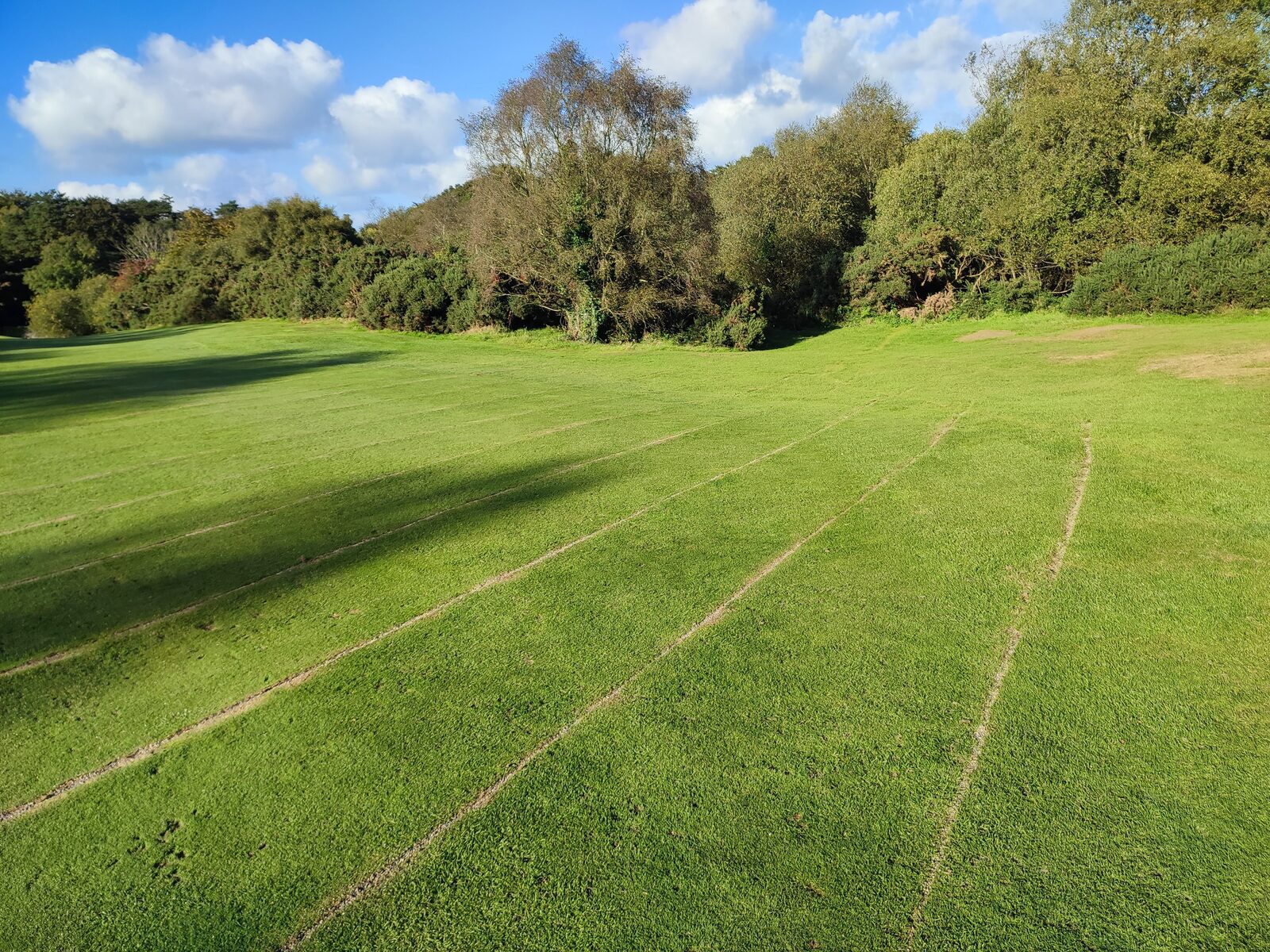
Here is an excellent example of gravel banding, carried out in September when the ground was dry so there is little surface damage. The gravel is exposed at the top so that water can clear quickly, and the bands connect into existing drains at either side of the fairway.
6. Verti-draining and soil aeration
Verti-draining is another valuable tool when used correctly. When carried out in dry conditions, it:
- Fractures compacted soils
- Improves movement of water, air and roots
- Enhances turf quality and resilience
However:
It does not solve drainage problems where soils are inherently impermeable.
It can be effective on permeable soils and may reduce the need for extensive drainage systems.
7. Shockwave aeration - where it fits
Shockwave machines are now widely used on golf courses to relieve compaction and improve surface permeability. They work by:
- Cutting deep vertical slits into the soil
- Fracturing and loosening compacted layers
- Improving movement of water, air and roots
Used in the right conditions, they can be effective at improving infiltration and surface conditions over large areas.
However:
They do not replace properly functioning drainage systems.
If underlying drainage is poor or ineffective, shockwave treatment will not solve the problem. Water may move more easily through the soil, but it still needs somewhere to go.
Their effectiveness is therefore greatest where:
- Drainage systems are already in place and functioning
- Compaction is restricting performance
- Soils have some natural permeability
As with other aeration techniques, the benefits can be temporary and treatments may need to be repeated.
Shockwave aeration is a useful maintenance tool, not a substitute for proper drainage.
8. A maintenance mindset
Drainage should not be treated as a one-off installation. It requires:
- Periodic inspection
- Occasional intervention
- Ongoing management
Failure to maintain existing drains often leads to:
- Declining performance
- Repeated problems
- Unnecessary new drainage works
Final thoughts
Many drainage systems continue to function well below their potential simply because they have not been maintained.
Restoring existing drains is often straightforward, far less disruptive, and significantly more cost-effective than installing new systems.
The key is not just installing drainage, but keeping it working effectively.