
The Business Case for Robotic Mowing

Looking beyond the purchase price
Golf Greens Committees are asking the question: “Will robotic mowing save money?”
It’s a perfectly reasonable question, but it isn’t the most useful one. The better question is: “What is the overall business case for our golf club?”
The purchase price of robotic mowers is easy to compare with conventional machinery, and estimating annual running costs is usually straightforward. However, some of the most significant benefits of robotic mowing are much more difficult to express in pounds and pence.
Improved winter playability, an extended effective playing season, less damage to wet fairways, and more time for course improvement work may ultimately prove more valuable than the direct financial savings.
This Technical Note explains a practical approach to assessing both the measurable costs and the wider operational benefits of robotic fairway mowing.
Why this calculator was developed
Golf clubs are increasingly interested in robotic mowing, but many struggle to compare it fairly with conventional mowing. Some focus almost entirely on the purchase price. Others look only at labour savings. Neither approach tells the whole story.
The Golf Robot Business Case Calculator has therefore been developed to help clubs compare the measurable annual cash costs of conventional and robotic mowing, while recognising that many important operational benefits cannot easily be expressed in financial terms.
It is intended to support informed discussion by Greens Committees, Course Managers, and Treasurers, rather than promote any particular manufacturer or system. In this early phase of robotic mower development, it is likely that many clubs will choose to retain one or more conventional mowers and that robots will be part of a “hybrid” system, which is what the Calculator assumes.
A good business case has two parts
Every business case should consider both measurable financial information and the wider operational benefits.
Measured annual cash costs
These can usually be estimated with reasonable confidence:
- Machinery purchase and replacement costs
- Fuel and electricity
- Maintenance and servicing
- Labour costs associated with fairway mowing
- Annual operating costs
These calculations provide an objective comparison of the annual cash costs of conventional and robotic mowing.
Additional greenkeeper capacity
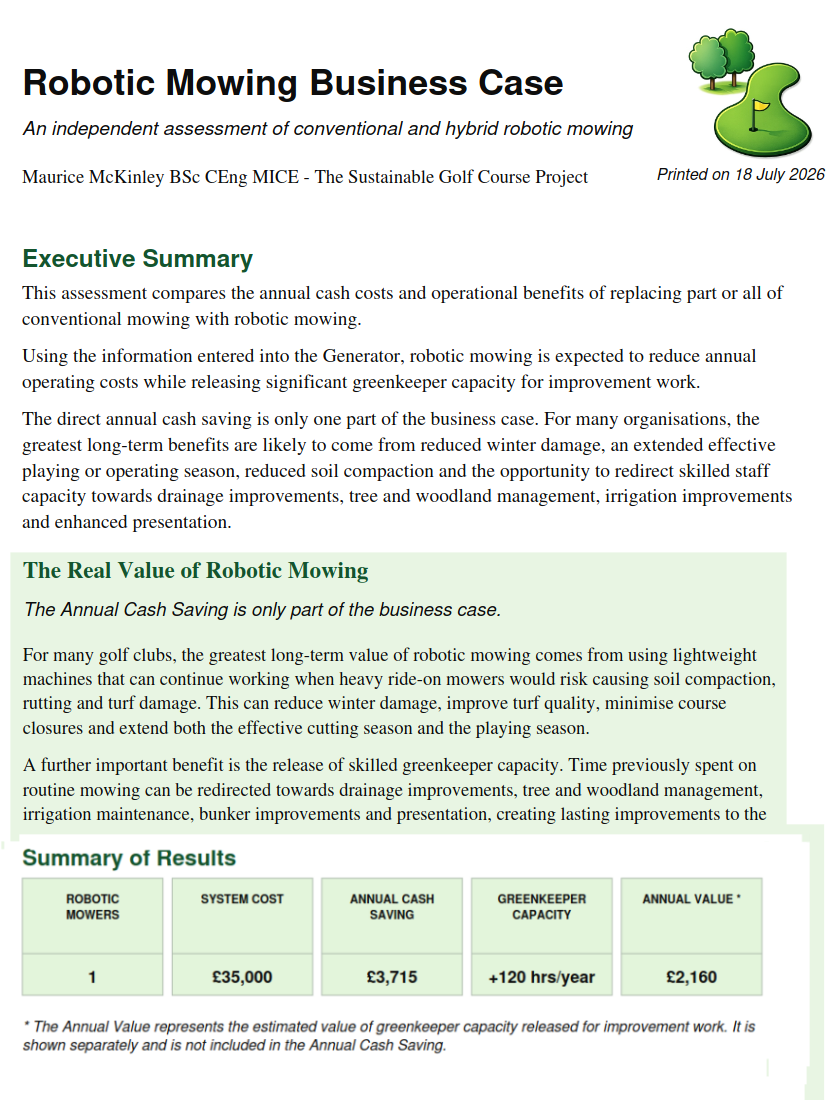
The calculator also estimates the amount of skilled greenkeeper capacity released by robotic mowing. This is not treated as a financial saving, but is shown separately, because it represents valuable time that can be redirected towards course improvement work such as drainage improvements, bunker maintenance, tree and woodland management, irrigation improvements, and course presentation.
Benefits not included in the cash cost comparison
Many of the most valuable benefits vary from club to club and therefore cannot be calculated reliably. These may include:
- Improved winter playability
- Potential to extend the effective playing season
- Reduced soil compaction and rutting
- Ability to maintain wetter areas throughout the winter
- Better grass control entering the main growing season
- Reduced diesel consumption and emissions
- Improved member satisfaction
- Potential for increased visitor golf and green fee income
A good business case considers all the potential benefits, not just costs.
Where do the real benefits come from?
Much of the discussion surrounding robotic mowing concentrates on labour savings. In practice, the greatest long-term benefits may come from something quite different.
Lightweight robotic mowers can often continue working when conventional ride-on mowers would risk damaging saturated ground. This helps keep grass under control throughout the winter, reducing spring recovery work and improving the presentation of wet areas.
Perhaps more importantly, robotic mowing releases skilled greenkeeper capacity for work that directly improves the golf course. This may include:
- Drainage improvements
- Bunker maintenance
- Tree and woodland management
- Irrigation improvements
- Tee and approach improvements
- Course presentation
- Environmental improvement projects
These activities often improve the golf course for many years, whereas routine mowing simply maintains it.
Using the Business Case Calculator
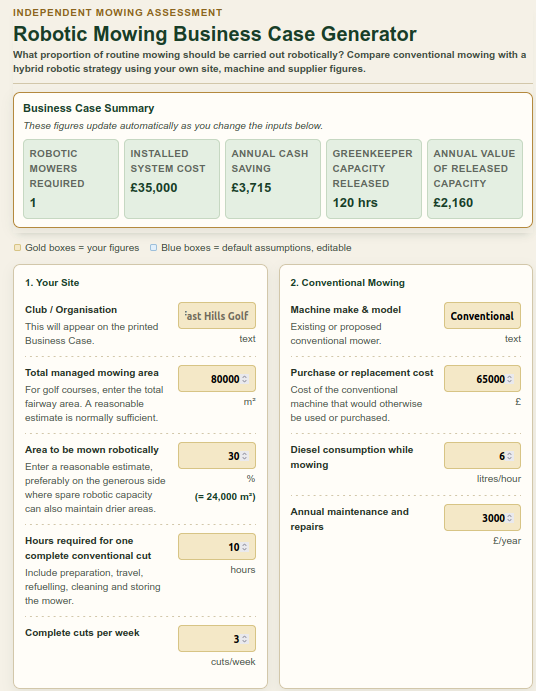
The calculator has been designed to be as simple as possible. Most clubs only need to enter:
- Total fairway area
- Percentage to be mown robotically
- Hours currently required to mow all fairways
- Typical annual mowing period
- Greenkeeper hourly employment cost
- Machinery costs
The calculator then estimates:
- Robotic mower requirements
- Annual operating costs
- Annual cash savings
- Additional greenkeeper capacity released
- Equivalent annual value of that capacity
It also produces a committee-ready Golf Robotic Mowing Business Case summarising the results.
Final thoughts
No calculator can make a decision for a golf club. It can only provide reliable information on those costs and savings that can reasonably be measured.
Many of the wider operational benefits discussed in this Technical Note will vary according to local soils, drainage, climate, course layout, and management priorities. For some clubs, these wider benefits may ultimately prove more valuable than the direct annual cash saving itself.
The bottom line
The calculator measures what can reasonably be measured. The Committee must then consider the wider benefits that cannot easily be expressed in financial terms.
Only by considering both can the overall business case for robotic mowing be properly assessed.
Related publications
- Technical Note 8, The Biggest Change in 50 Years
- Golf Robot Business Case Calculator
- TN9, Instructions for Using the Calculator